


Put the H (healthy) in Your H₂O
World Water Day was first proposed in 1992 at the United Nations Conference for Environment and Development in Rio de Janeiro. It went into effect the following year and the first World Water Day was March 22nd, 1993.
Each year a different theme is highlighted to bring awareness to water issues in several different areas. The day is used to advocate for…
““Nothing is softer or more flexible than water, yet nothing can resist it.””
Water is Life.
March 22 is World Water Day.
World Water Day was first proposed in 1992 at the United Nations Conference for Environment and Development in Rio de Janeiro. It went into effect the following year and the first World Water Day was March 22nd, 1993
Each year a different theme is highlighted to bring awareness to water issues in several different areas. The day is used to advocate for the sustainable management of freshwater resources.
The theme for World Water Day 2018 was “Nature for Water”, exploring nature-based solutions to the water challenges we face in the 21st century. In 2019, the theme was “Leaving no one behind” to emphasize that as a society, we cannot leave anyone behind as sustainable development progresses. The 2020 theme for World Water Day was “Nature and Climate Change”, which focused on the link between water and climate. This year’s theme is to answer the question, “What water means to you?”.
On this day we are all asked to “Take action, wherever you are and whatever you do on March 22, make it about water and what that means to you” For my part, and as a physiologist, water is life.
We are 65 to 70% water. It is essential for our existence and is vital to all physiological systems in our body. We need to maintain balance in our bodies, what we call homeostasis. To maintain a healthy body, we need to stay well hydrated with pure, healthy water the way nature intended.
We also need to Nurture the Nature of our planet to keep it in a state of balance and health or in other words, environmental homeostasis. Water is the most prevalent compound on earth and safeguarding this vital resource and awareness to act is the paramount goal of World Water Day. We must be diligent and make this part of our day-to-day activities and actions to help safeguard and improve our global water resources.
Here are few examples of simple actions that we can do to help with nurturing the earth’s water resources.
1. Take shorter showers.
The average American showers about 6 times a week for an average time of 8.2 minutes, using 17.2 gallons of water. Over the span of a year, this uses 5,336 gallons of water. Multiply this number to account for the other 328 million Americans and you’ll find the nation uses about 1.8 trillion gallons of water a year showering. This can be significantly reduced by shortening showers to 5 minutes.
2. Meat-free Mondays.
National Geographic calculates the average hamburger takes about 630 gallons of water to produce. Both animals and their feed sources require water, which means the meat has an especially large water consumption footprint, with beef being the highest. By comparison, plants use far less water which is why many environmentalists encourage people to go meatless at least once a week. In fact, Meat-Free Mondays have even become a popular trend among celebrities, chefs, and health advocates as well. Each meatless meal saves nearly 133 gallons of water, so do your part by going meatless at least once a week.
3. Turn off the tap when brushing your teeth and washing dishes.
On average, about two gallons of water flow from a faucet each minute—meaning you can save about three to four gallons of water per day by simply turning off the water while brushing your teeth. In addition, turn off the tap while doing other daily tasks such as shaving and washing dishes. These simple alterations add up, saving thousands of gallons of water each year by simply turning off the tap when you are not directly using it.
4. Filter your water.
Filtering water in your home is one of the best things you can do to help address the water crisis. Not only do you get to enjoy clean, healthy water—but filtering your water at home prevents the need for practices such as “flushing”—in which people run cold tap water for several minutes before drinking it. This process has not only been found to be ineffective, but it also wastes a significant amount of water. Instead, reduce contaminants using a dedicated water filter.
Many people choose bottled water or water delivery services because they do not trust their tap water or they object to the taste or smell of tap water. A filter provides a great way to eliminate those issues at home without the need to buy bottled water. You can eliminate bottled water and enjoy healthy, great-tasting water at home for a fraction of the cost while also making an environmentally conscientious choice.
5. Use your own water bottle.
Did you know that it takes at least twice as much water to produce a plastic water bottle as the amount of water contained in that bottle? Additionally, single-use, plastic water bottles take up to 1000 years to biodegrade and approximately 80% of these water bottles will end up in our landfills and oceans. The manufacture and distribution of single plastic water bottles are also a significant source of carbon emissions. Any way you look at it, bottling water is a tremendous waste as far as resources and a major contributor to the pollution of our planet and wasteful of our most essential nutrient, Water.
Rather than relying on single-use plastic bottles which wastewater in production and have huge environmental impacts, use a reusable water bottle to do your part and help the planet. Filter your water at home and use your favorite bottle of choice or use a water bottle with a built-in filter to reduce contaminants and provide pure, healthy water on the go.
The solution to our global water issues and the plastic pollution of our planet is very complex and people often wonder what they can do as individuals to make a positive impact. One thing we all can do is not to contribute to landfills by filtering tap water rather than purchasing bottled water. In recent blogs, we have talked about the pollution problem with bottled water and about how to choose a water filtration system.
Filtering our tap water is convenient, cost-effective, and the best way to provide ourselves and our families with healthy water. Our personal choice for water filtration is the Nikken Waterfall. Imagine if we could create fresh spring water in our own home or office? This is the strategy behind the Nikken Waterfall. The Nikken Waterfall System is an advanced, technically sophisticated, well-designed countertop home filtration system that converts tap water into fresh spring-like water. It’s as if Mother Nature poured you a glass of water.
For water on the go, the Nikken PiMag Sport Bottle is an excellent choice. Fill from any water fountain or tap and enjoy fresh spring-like water anywhere municipally treated water is available. The PiMag Sport Bottle uses patented nan-filtration and is made from bio-degradable materials. One PiMag Sport Bottle can replace 1400 single-use plastic water bottles per year that pollute our planet and consume our natural resources.
The Solution that is a Healthy Choice for our Bodies and our Planet.
Nikken considered fundamental aspects for its water systems including the application of the types of plastics used for water filtration and storage to provide clean healthy water free of pollutants found in bottled water and many other types of water filtration units. Equally important to our mission and philosophy is to reduce pollution by contributing to the reduction of the consumption of plastic bottles in the world. For more information read Environmentally Responsible Water Filtration.
Be Healthy by Choice

Drink to Your Health
Proper hydration is essential for a healthy immune system and at this specific point in time concerning the global pandemic it is of paramount importance for us all.
Even mild dehydration can decrease…
“Water your roots, so your soul can blossom.”
Life cannot exist without water!

Proper hydration is essential to a healthy life. Water comprises over two-thirds of our body weight and is one of the most essential elements of maintaining well-being. Water is important in every physiological process. Water helps your body with circulation, assimilation, digestion, elimination, and temperature control.
Researchers estimate that about 75% of Americans are chronically dehydration. This can lead to many health issues such as fatigue, joint pain, headaches, weight gain, type 2 diabetes, ulcers, and high blood pressure. Chronic dehydration may affect your organs and lead to kidney stones, cholesterol problems, constipation, and liver and muscle damage.
Water and Immune Function

Proper hydration is essential for a healthy immune system and at this specific point in time concerning the global pandemic it is of paramount importance for us all.
Even mild dehydration can decrease salivary rate and decrease the concentration of salivary immunoglobulin A (s-IgA), which is one of the first lines of defense of the immune function on pathogens.
Maintaining healthy skin is another primary barrier to potential pathogens. In addition to providing a passive physical barrier against infection, the skin also contains elements of the innate and adaptive immune systems which allow it to actively fight infections. Proper hydration is a prerequisite for healthy skin.
Staying hydrated helps the body naturally eliminate toxins and other bacteria that may cause illness. Dehydration reduces the overall volume of blood and lymphatic fluids that are integral to a healthy immune system.
Lymph flows throughout the body to collect bacteria and waste. It transports collected waste to the lymph nodes which serve as filters. Drinking water works like a waterfall for lymphatic organs. The higher the amount, the stronger the push to the edge. In this scenario, water pushes bodily waste into the lymph nodes where lymphocytes destroy them. Eliminating toxins and waste materials become a difficult task when dehydrated. Not being able to remove this debris, your body is more susceptible to infection. Not staying hydrated diminishes energy levels, leading to a lack of exercise and a weakened immune system.
Water is vital for the functioning of all of your organs, and it’s a huge part of keeping your immune system functioning at an optimal level,” says Dr. Jyothi Tirumalasetty, assistant professor of medicine at UCLA Health Department of Clinical Immunology and Allergies. “We are made of 60 percent water. If we are dehydrated, the whole system of immunity could start breaking down.”
Water is not just a beverage choice
Water is not just a beverage choice; it is our most essential nutrient. When we think of water in this way it becomes apparent that we must drink enough each day. We can live for 3 weeks without food, but only 3 days without water!
Be Healthy by Choice.

Save You, Your Family and the Planet
One of the most important aspects of the Wellness Home is to provide ourselves and our families with clean, healthy water, that isn't killing our planet.
"We forget that the water cycle and life cycle are one"
Water Matters and the Wellness Home

One of the most important aspects of the Wellness Home is to provide ourselves and our families with clean, healthy water.
Water is not just a beverage choice, it is an essential nutrient. We have been saying this for years and the reason why is we tend to choose just about everything else to drink other than water. That is the main reason why over 75% of us walk around dehydrated every day. I advocate drinking half your body weight in ounces of healthy water per day.
We have choices for different types of drinking water: tap water, filtered water and bottled water.
The solution to our global water issues and the plastic pollution of our planet is very complex and people often wonder what they can do as individuals to make a positive impact. One thing we all can do is to not to contribute to landfills by filtering tap water rather than purchasing bottled water. In recent blogs we have talked about the pollution problem with bottled water and about how to choose a water filtration system.
Filtering our tap water is convenient, cost effective and the best way to provide ourselves and our families with healthy water.
What do we use in our Wellness Home?

Our personal choice for water filtration is the Nikken PiMag Waterfall. Imagine if we could create fresh spring water in our own home or office? This is the strategy behind the Nikken Waterfall. The Nikken Waterfall System is an advanced, technically sophisticated, well designed countertop home filtration system that converts tap water into fresh spring-like water. Using a multi-stage filtration process which cleans, alkalizes, mineralizes, ionizes, energizes and oxygenates the water, the Waterfall produces a light, velvety fresh-tasting water which is highly absorbed and healthy.
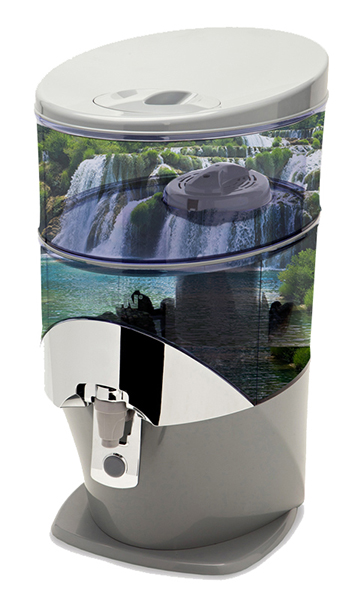
PiMag Waterfall
Put simply, the Waterfall produces water the way nature intended water to be. Free of contaminants but maintaining an alkaline pH with minerals that are added back after the filtration process. The water is run through a magnetic field that provides a water structure as it occurs in nature.
The Waterfall Gravity Water System has a modern, compact profile and fits conveniently into most kitchen environments. All Nikken water products are designed to the highest standards, using non-leaching, and free of BPA and other estrogenic chemicals. With its Gold Seal of Approval from the Water Quality Association, the Waterfall meets rigorous standards for performance, capacity, and integrity, removing a variety of drinking water contaminants.
The Nikken Waterfall meets contaminant-reduction specifications of National Sanitary Foundation (NSF) Standards 42 and 53 and reduces objectionable tastes, odors, colors, aesthetic chlorine, chloramines, VOCs and mercury from municipally treated tap water. This is considerably better performance than you'd get with many conventional faucet or pitcher--type or water filters. The filtration efficiency is equivalent to more complex and expensive water filtration systems costing $1000’s of dollars.
The water tank components are bio-degradable plastics that will not leach potentially harmful chemicals into the contents of the tank. Nor will they release these chemicals into the soil. The Waterfall is environmentally responsible in several ways. It reduces the number of discarded plastic water bottles that become trash in landfills. This also decreases consumption of fossil fuels used in manufacturing those bottles. The waterfall is made with recyclable and biodegradable materials, including a polymer that does not leach chemicals into water as some plastics will.
Features and Benefits that we like most about our Waterfall:
Multiple-stage filtering process, advanced water-contaminant reducing technology
Certified filtration to reduce contaminants, NSF Certification 42, 53 and 372
Gold Seal of Approval from the Water Quality Association
Natural, gravity-fed filtration – no need for electricity or plumbing, can be used is any location
Minerals added back to adjust pH to create alkaline water
Fits perfectly onto kitchen counter-top
Non-leaching and BPA free materials
Made of bio-degradable plastics for no environmental impact
Ease of operation and maintenance
Cost effective solution for healthy water
The Waterfall is good for your family, your pocketbook and our planet! It is an integral component of the Nikken Wellness Home.
Water Matters and is a vital component of every Wellness Home.
Be Healthy by Choice, not by Chance.

If Mother Nature Poured You a Glass of Water...
The solution to our global water issues and the plastic pollution of our planet is very complex and people often wonder what can they do as individuals to make a positive impact.
If Mother Nature Poured You a Glass of Water...

The solution to our global water issues and the plastic pollution of our planet is very complex and people often wonder what can they do as individuals to make a positive impact. One thing we all can do is to not to contribute to landfills by filtering tap water rather than purchasing bottled water. In recent blogs we have talked about the pollution problem with bottled water and about how to choose a water filtration system.
Waterfall for Healthy Water

Filtering our tap water is convenient, cost effective and the best way to provide ourselves and our families with healthy water. Our personal choice for water filtration is the Nikken Waterfall. Imagine if we could create fresh spring water in our own home or office? This is the strategy behind the Nikken Waterfall. The Nikken Waterfall System is an advanced, technically sophisticated, well designed countertop home filtration system that converts tap water into fresh spring-like water. Using a multi-stage filtration process which cleans, alkalizes, mineralizes, ionizes, energizes and oxygenates the water, the Waterfall produces a light, velvety fresh-tasting water which is highly absorbable and healthy.
Put simply, the Waterfall produces water the way nature intended water to be. Free of contaminants but maintaining an alkaline pH with minerals that are added back after the filtration process. The water is run through a magnetic field that provides a water structure as it occurs in nature.
The Waterfall Gravity Water System has a modern, compact profile and fits conveniently into most kitchen environments. All Nikken water products are designed to the highest standards, using non-leaching, and free of BPA and other estrogenic chemicals. With its Gold Seal of Approval from the Water Quality Association, the Waterfall meets rigorous standards for performance, capacity, and integrity, removing a variety of drinking water contaminants.
The Nikken Waterfall meets contaminant-reduction specifications of National Sanitary Foundation (NSF) Standards 42 and 53 and reduces objectionable tastes, odors, colors, aesthetic chlorine, chloramines, VOCs and mercury from municipally treated tap water. This is considerably better performance than you'd get with many conventional faucet or pitcher--type or water filters. The filtration efficiency is equivalent to more complex and expensive water filtration systems costing $1000’s of dollars.
The water tank components are bio-degradable plastics that will not leach potentially harmful chemicals into the contents of the tank. Nor will they release these chemicals into the soil. The Waterfall is environmentally responsible in several ways. It reduces the number of discarded plastic water bottles that become trash in landfills. This also decreases consumption of fossil fuels used in manufacturing those bottles. The waterfall is made with recyclable and biodegradable materials, including a polymer that does not leach chemicals into water as some plastics will.
Features and Benefits that we like most about our Waterfall:
· Simple operation
· Multiple-stage filtering process, advanced water-contaminant reducing technology
· Certified filtration to reduce contaminants, NSF Certification
· Gold Seal of Approval from the Water Quality Association
· Natural, gravity-fed filtration – no need for electricity
· Minerals added back to adjust pH to create alkaline water
· Filter life LED indicator (The filter-life LED indicator turns from green to red when it is time to replace the filter)
· Fits perfectly onto kitchen counter-top
· Non-leaching and BPA free materials
· Made of bio-degradable plastics for no environmental impact
· Ease of operation and maintenance
· Cost effective solution for healthy water
· Does not require a power source which makes it perfect for power outages or travel
The Waterfall is good for your family, your pocketbook and our planet!
Find out more from your Nikken Wellness Consultant.
Be Healthy by Choice, not by Chance.

What to Look for in a Water Filtration System
I think the most important aspect when deciding on a system for healthy water is...
What to Look for in a Water Filtration System

We all need water, as I say, “Water is not just a beverage choice, it is our most essential nutrient”. Replacing our daily water needs is paramount to being Healthy by Choice. If you are a fan of The Impetus you are already aware that bottled water is not the choice I recommend (see Is Bottled Water Healthier than Tap Water). Given that tap water is 2000 times less expensive than bottled water and that municipal tap water is monitored and regulated, the healthy choice is to filter your tap water.
There are many choices for home water filtration. Each person’s needs and expectations are different. The best water filter for you depends on what's in your water and what you want to remove. For many people, an aesthetic choice for improving taste and smell is all they are interested in, but for those wanting healthy water, removal of noxious contaminants and chemicals is imperative. Cost is a major concern and can range from inexpensive pitchers, faucet mount systems and refrigerator door filters, ($20 to $100) for aesthetic concerns to high priced under-counter or whole house systems ($1000 up) for improving taste and smell and removal of toxic substances. Each can have their merits and shortcomings.
The Most Important Aspect is Removal of Harmful Chemicals

I think the most important aspect when deciding on a system for healthy water is the removal of harmful chemicals and contaminants. Forty-four percent of the US population relies on groundwater for its drinking water supply, according to the National Ground Water Association, groundwater is at risk of pesticides, solvents, heavy metals, and volatile organic compounds that have seeped into the water table. Any company can say that its water filter removes contaminants, but the average person doesn’t have a lab or the means to confirm it’s factual. That’s why I strongly suggest getting a system that has third-party corroboration in the filters effectiveness in removing harmful substances. The American National Standards Institute (ANSI) and the National Sanitation Foundation (NSF) have set water treatment standards, and agencies like the NSF and the Water Quality Association (WQA) test against those standards. A filter certified for both NSF-42 and NSF-53 standards is recommended.
NSF-42 Filters that are certified to reduce aesthetic impurities such as chlorine and taste/odor. These can be point-of-use (under the sink, water pitcher, refrigerator, etc.) or point-of-entry (whole house) treatment systems. These filters improve taste and odor by reduction of chlorine and chloramine.
NSF-53 certifies the reduction of metals and chemicals that can affect your health. NSF-53 is a bit more complex as multiple compounds fall under this certification and they’re each certified separately. Reduction of mercury and volatile organic compounds (VOCs).
I also recommend a system that is certified NSF-372 to remove heavy metals such as lead from water. The main threats to human health from heavy metals are associated with exposure to lead, cadmium, mercury and arsenic.
An effective way of providing yourself and your family with healthy water is filtration of tap water. There are many types of systems to accomplish this. Common methods of filtering can remove the chemicals but it also removes important minerals our bodies need. Guidelines I suggest looking for when comparing systems are advanced filtration that is corroborated and meet or exceed ANSI/NSF standards of 42 and 53. Look for a system that adds minerals back to the water and creates a slightly alkaline water. I am also a proponent of micro-clustered water that helps with absorption and I suggest getting a system that is easy to use and maintain and cost effective.
We use a system in our home that sells for about $400 that meets all these guidelines. We use a sports bottle for healthy water on the go and filter our shower/bath water. Visit the H2O shop in the Emporium for product details.
Not only do we want healthy choices for our bodies, but also for our planet. I advocate for systems such as these that are environmentally responsible and made with recyclable and biodegradable materials.
What do you want in a home/on the go water filtration system? Enter a comment below. Let's chat.
Be Healthy by Choice, not by Chance

Bottled Water vs. Tap Water
Scientists at Texas Southern University evaluated 35 brands of bottled water and found...
Is Bottled Water Healthier than Tap Water?

One reason that many people choose bottled water is that they think it’s a healthier choice than tap water. This is good news as many people are looking for healthier options. In fact, 2017 is the first year that bottled water sales have exceeded soda sales in the United States. Bottled water consumption in the U.S. hit 39.3 gallons per capita last year, while carbonated soft drinks fell to 38.5 gallons, marking the first time that soda was knocked off the top spot.
More than one-quarter of bottled water revenue last year was shared by the soda giants Coca-Cola Co. and PepsiCo which sell Dasani and Aquafina respectively. In the four decades since the launch of Perrier water in the U.S., consumption of bottled water surged 2,700%, from 354 million gallons in 1976 to 11.7 billion gallons in 2015, according to the International Bottled Water Association.
Ok, some people are making healthier choices to drink water instead of soda, but is their choice to drink bottled water rather than tap water fact founded or just the results of good marketing by bottled water companies. People are led to believe that bottled water is spring water with the advertisements and labels portraying pristine mountain streams, waterfalls, or glacial Alpine landscapes. However, nearly 50% off all bottled water is tap water, according to Peter Gleick, a scientist and author of “Bottled and Sold: The Story Behind Our Obsession with Bottled Water.”
Contrary to the image of purity advertised by the bottled water industry, bottled water may contain a lot more than simple H2O. In 2008, testing commissioned by Environmental Working Group (EWG), found 38 pollutants in 10 brands of bottled water, including disinfection byproducts, industrial chemicals, radioactivity and bacteria. Two of the brands tested bore the chemical signature of municipal tap water, meaning that they were chemically indistinguishable from what comes from the faucet.
In 2008, scientists at Texas Southern University evaluated 35 brands of bottled water and found that four were contaminated with bacteria. In 1999, the Natural Resources Defense Council tested 103 bottled waters and detected potentially worrisome contaminants, including microbes and regulated chemicals, in about 50% of the samples tested.
This is a quite disturbing from a financial standpoint as bottled water is 2,000 times more expensive than tap water. Another perspective would be going to a sandwich shop for a six-dollar sandwich and paying $12,000 dollars for that sandwich. Just because it is marketed as a healthier sandwich, would we make the same choice. No way.
Don’t we all too often trade convenience at the expense of our health?

The other reason people tell me that they choose bottled water is that it is convenient. My response to that is, don’t we all too often trade convenience at the expense of our health?
Drinking plenty of water is good for your health, but both tap and bottled water can contain contaminants that may be harmful. The best option for getting the safest water possible is to filter your tap water. There are many different types of water filters at a wide range of efficiency and pricing. I suggest selecting a system certified by NSF International. NSF certifies drinking water filters to standards applicable to each type of treatment option. You may notice the NSF mark on a product along with numbers such as NSF/ANSI 53 or NSF/ANSI 42, which refer to the standard to which the filter has been certified. These models are designed to filter out specific contaminants, so you can purchase one based on your needs.
NSF/ANSI standard 42 is for aesthetic properties of smell and taste. A healthy choice for a water filtration system would also conform to standard 53 for volatile organic compounds such as trihalomethane, trichloroethylene and many others. These standards should be published and readily available when deciding on which product to purchase. I would also recommend a unit that complies with NSF/ANSI standard 372 for heavy metal reduction. Just as important in removal of harmful substances is the filter systems ability to add back beneficial properties and minerals for a healthy water the way Nature intended.
Be Healthy by Choice, not by Chance. Drink half your body weight in ounces a day of good quality, healthy water.
Author: Gary Lindner, PhD